Vibe Coding Explained: Why Everyone Is Talking About AI-Powered Programming
Just a few years ago, writing software meant spending hours typing every line of code by hand, searching documentation, fixing syntax errors, and debugging problems one at a time. Artificial intelligence has changed that reality faster than almost anyone expected. Today, developers can describe an idea in plain English, and an AI assistant generates functional code within seconds. This new way of building software has become known as Vibe Coding, and it’s rapidly transforming how both beginners and experienced programmers approach development.
Unlike traditional programming, Vibe Coding focuses less on memorizing syntax and more on communicating ideas. Developers describe what they want to build, while AI models generate code, explain functions, suggest improvements, and even fix bugs automatically. Instead of acting as a replacement for programmers, AI becomes a collaborative partner that speeds up creativity and removes repetitive work.
The popularity of AI Coding tools has exploded thanks to advances in large language models. Platforms such as ChatGPT, Claude, Cursor, GitHub Copilot, and other AI-powered coding assistants have made software development more accessible than ever before. Even people with limited programming experience can now build websites, automate tasks, create mobile apps, and experiment with software projects that once required years of technical training.
In this guide, you’ll learn what Vibe Coding really means, why it’s becoming one of the biggest technology trends of the decade, how AI Programming works behind the scenes, and why many experts believe this approach represents the future of software development.

What Is Vibe Coding?
The phrase Vibe Coding describes a modern programming workflow where developers collaborate with artificial intelligence instead of writing every line of code manually. Rather than thinking primarily about syntax, programmers focus on solving problems, designing features, and explaining ideas clearly. AI handles much of the repetitive coding work while humans guide the overall direction of the project.
Imagine asking an AI assistant to build a responsive landing page, create a Python automation script, or generate a complete login system. Instead of starting from a blank screen, the AI produces a working foundation almost instantly. The developer then reviews the output, improves the architecture, adds business logic, and fine-tunes the final product.
This workflow dramatically reduces development time while allowing programmers to spend more energy on creativity, planning, and user experience. Many software engineers describe the process as having an intelligent coding partner available at any moment.
Although Coding with AI still requires human judgment, AI has become remarkably effective at generating boilerplate code, explaining unfamiliar libraries, translating between programming languages, writing documentation, and identifying potential bugs before software reaches production.
Why Vibe Coding Is Growing So Quickly
Several technology shifts have combined to make Vibe Coding one of the fastest-growing trends in software development.
First, large language models have become dramatically better at understanding natural language. Instead of requiring precise technical prompts, modern AI assistants understand conversational requests, making programming feel much more intuitive.
Second, development tools have evolved rapidly. Editors such as Cursor integrate AI directly into the coding environment, allowing developers to generate, edit, explain, and refactor code without constantly switching between applications. This seamless workflow significantly improves productivity.
Third, businesses increasingly need software delivered faster than ever before. Companies want websites, internal tools, automations, APIs, dashboards, and mobile applications built in weeks instead of months. AI Programming helps teams move from idea to prototype at unprecedented speed.
Perhaps the biggest reason for the popularity of Vibe Coding is accessibility. People who previously felt intimidated by programming can now begin learning through conversation instead of memorization. AI explains concepts, answers questions instantly, and helps learners understand mistakes without waiting for classroom instruction.

The Best AI Coding Tools Powering the Vibe Coding Movement
Today’s Vibe Coding ecosystem includes several powerful tools that make AI-assisted development accessible to millions of users.
ChatGPT helps developers brainstorm solutions, generate code snippets, explain algorithms, debug errors, and write documentation. It has become one of the most widely used coding assistants for beginners and professionals alike.
Claude excels at understanding long codebases and producing thoughtful explanations, making it especially useful for reviewing complex projects and improving software architecture.
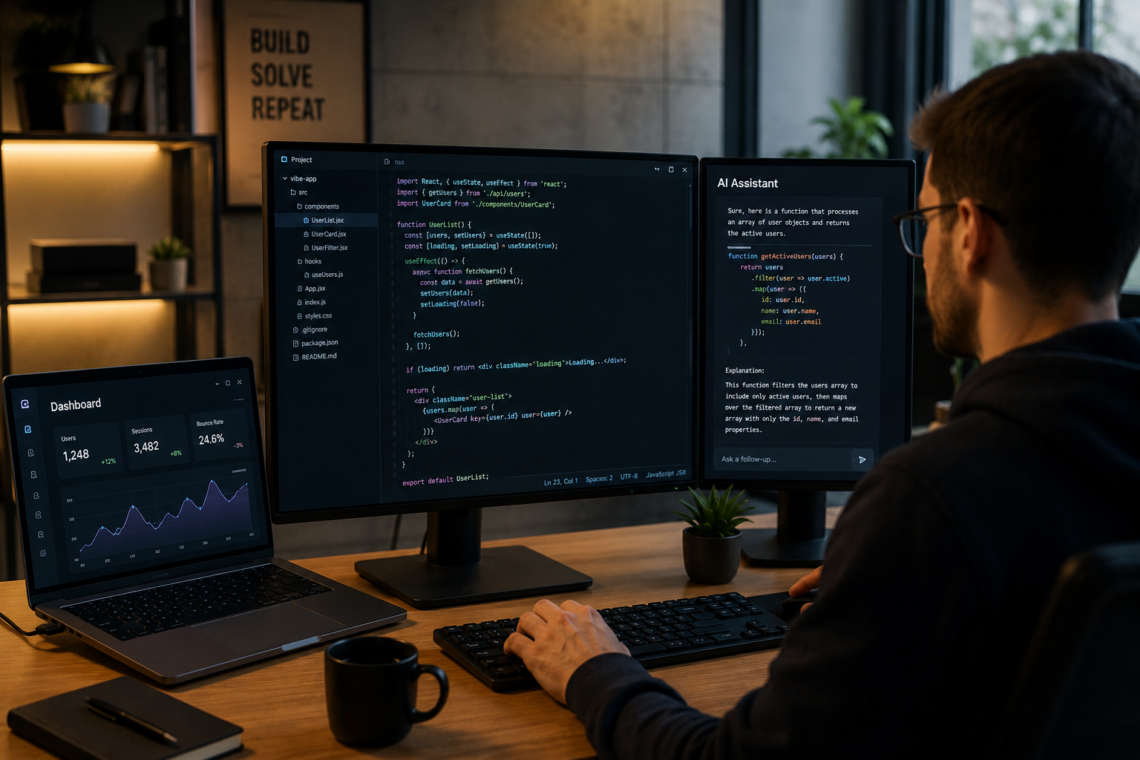
Cursor has become one of the defining applications behind AI Coding because it integrates advanced AI directly into the code editor. Developers can edit entire files, refactor projects, and generate new features using simple natural-language instructions without interrupting their workflow.
Meanwhile, GitHub Copilot continues to provide intelligent autocomplete suggestions, helping programmers write code significantly faster while reducing repetitive typing.
Together, these platforms demonstrate that AI Programming is no longer an experimental concept—it’s becoming a standard part of modern software development.
The Biggest Benefits of Vibe Coding
The rapid growth of Vibe Coding isn’t simply about writing code faster. Its real advantage lies in changing how developers think about software creation. Instead of spending hours searching documentation, fixing syntax errors, or writing repetitive functions, programmers can focus on solving real problems while AI handles much of the routine work.
One of the most significant advantages is productivity. Tasks that previously required an afternoon can often be completed within minutes. Creating API endpoints, building responsive user interfaces, generating SQL queries, writing unit tests, and documenting functions all become dramatically faster with modern AI Coding assistants.
Another major benefit is creativity. Developers often describe AI as a brainstorming partner rather than an automated code generator. When facing a difficult problem, AI can suggest multiple solutions, explain the advantages of different approaches, and even recommend technologies that better fit a particular project.
Businesses also benefit. Faster development cycles mean quicker prototypes, shorter release schedules, and more time spent improving user experience instead of repeating boilerplate tasks. For startups especially, AI Programming significantly lowers the barrier to launching new products.
Perhaps most importantly, Coding with AI makes software development more approachable for people who previously believed programming was too difficult to learn.

Can Beginners Learn Programming Faster with AI?
One of the most exciting aspects of Vibe Coding is its ability to accelerate learning. Beginners no longer have to rely solely on textbooks or lengthy documentation to understand programming concepts. Instead, AI explains errors in plain language, provides examples, and answers follow-up questions instantly.
Imagine learning JavaScript, Python, or HTML. Instead of copying tutorials without understanding them, learners can ask why a particular function works, request alternative solutions, or explore different programming techniques through conversation. This interactive learning style feels much more natural than traditional study methods.
AI also encourages experimentation. Beginners are more willing to test ideas because mistakes become learning opportunities rather than frustrating roadblocks. If code doesn’t work, an AI assistant can explain the error, suggest improvements, and describe exactly why the solution failed.
However, successful developers still need to understand programming fundamentals. AI can generate impressive code, but knowing how software works, how databases communicate, and why algorithms matter remains essential for building reliable applications.

Will AI Replace Software Developers?
This question appears in almost every discussion about Vibe Coding, and the answer is more nuanced than many headlines suggest.
Artificial intelligence is becoming remarkably capable of generating code, explaining complex systems, and automating repetitive programming tasks. Yet software development involves far more than writing syntax. Developers design architectures, understand business requirements, make security decisions, optimize performance, collaborate with teams, and solve problems that require human judgment.
Rather than replacing programmers, AI is changing their responsibilities. Developers increasingly act as architects, reviewers, and decision-makers while AI accelerates implementation. The ability to communicate clearly with AI, evaluate generated code, and guide projects strategically is becoming just as valuable as writing code manually.
This shift resembles the introduction of calculators for mathematicians or design software for architects. Technology changed workflows but didn’t eliminate the professions themselves.
In the coming years, employers are likely to prioritize developers who know how to combine technical expertise with effective use of AI Developer Tools, creating software more efficiently than ever before.

Common Mistakes When Using AI Coding Tools
Although Vibe Coding offers incredible advantages, relying on AI without careful review can introduce serious problems. One of the most common mistakes is accepting generated code without understanding how it works. AI occasionally produces inefficient, outdated, or insecure solutions, especially when prompts lack detail.
Another frequent issue is vague prompting. Asking AI to “build a website” often produces generic results, while detailed instructions about functionality, design, security, and user experience usually generate much stronger code. Learning how to communicate clearly with AI has become an important skill in itself.
Developers should also remember that AI doesn’t automatically understand the full context of every project. Reviewing generated code, testing functionality thoroughly, and maintaining proper documentation remain essential responsibilities.
The most successful programmers treat AI as a highly capable assistant rather than an infallible expert. Combining human experience with artificial intelligence consistently produces better results than relying entirely on either one alone.

Frequently Asked Questions
What is Vibe Coding?
Vibe Coding is a modern approach to software development where programmers collaborate with AI assistants to generate, edit, explain, and improve code using natural language.
Is Vibe Coding only for experienced developers?
No. Beginners often benefit the most because AI explains programming concepts, fixes errors, and provides examples while they learn.
Which AI coding tool is the best?
Popular options include ChatGPT, Claude, Cursor, and GitHub Copilot. The best choice depends on your workflow, programming language, and personal preferences.
Can AI write complete applications?
AI can generate substantial portions of software, but experienced developers are still needed to design architecture, review security, optimize performance, and ensure code quality.
Should programmers still learn traditional coding?
Absolutely. Understanding programming fundamentals remains essential because AI works best when guided by someone who understands software engineering principles.
Conclusion
Vibe Coding represents one of the most significant shifts in software development since the rise of modern programming languages. By combining human creativity with artificial intelligence, developers can build applications faster, learn new technologies more efficiently, and focus on solving meaningful problems instead of repetitive coding tasks.
As AI Coding continues to evolve, the most successful developers won’t necessarily be those who memorize the most syntax—they’ll be the ones who know how to collaborate effectively with intelligent tools while applying strong programming fundamentals and critical thinking. Whether you’re an experienced software engineer, an entrepreneur building your first product, or a complete beginner curious about technology, Vibe Coding offers a glimpse into the future of programming—one where ideas move from imagination to working software faster than ever before.
The rapid evolution of AI code assistants is making software development more accessible, productive, and creative than ever. As these tools continue to improve, developers who learn to work alongside AI will be well positioned to build better applications, solve complex problems more efficiently, and shape the next generation of technology.


You May Also Like

AI Girlfriends & Virtual Companions 2025: Digital Love, Black Mirror Reality & AI Dating Apps Explored

AI Subtitles YouTube 2025: Real-Time Captions, Best Tools & Viral Content Hacks