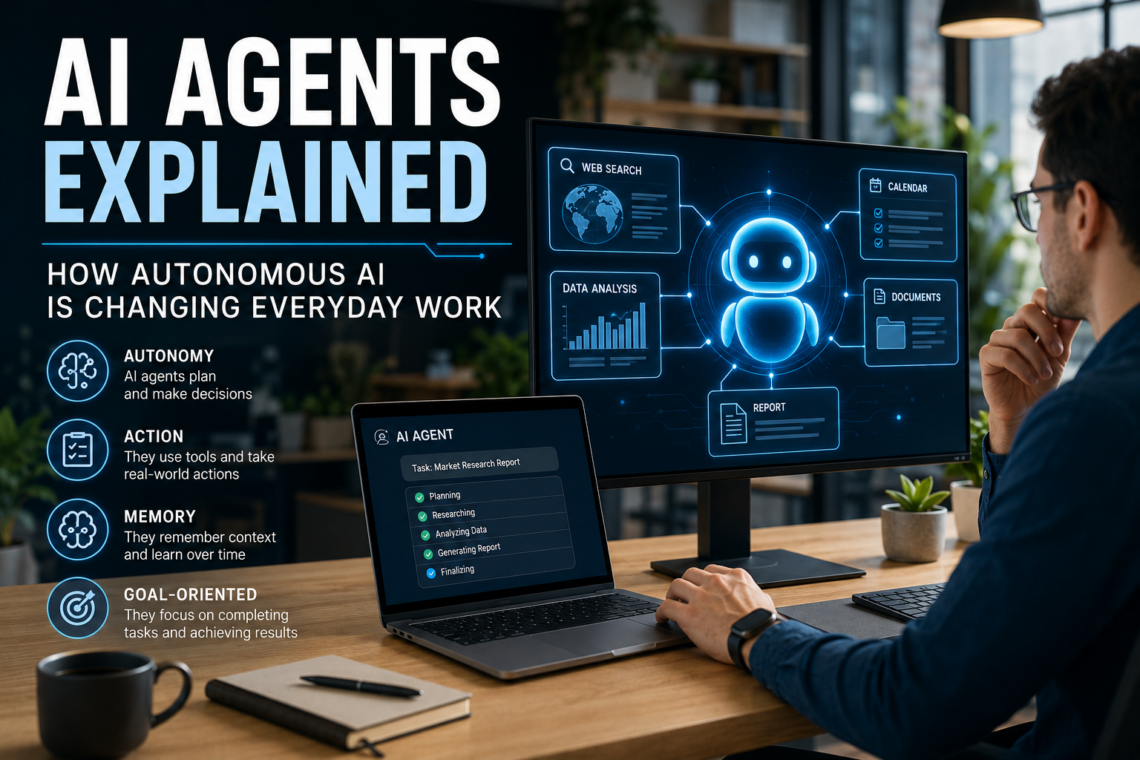
AI Agents Explained: How Autonomous AI Is Changing the Way We Work
Artificial intelligence has evolved far beyond answering simple questions or generating text. Today’s AI systems are becoming increasingly capable of making decisions, completing multi-step tasks, and working with minimal human supervision. These intelligent systems are known as AI Agents, and they’re quickly becoming one of the biggest trends in technology.
Unlike traditional AI chatbots that simply respond to prompts, AI Agents can plan, reason, remember previous interactions, use external tools, and complete complex workflows automatically. Instead of asking an AI to perform one task at a time, users can assign a broader objective while the AI determines the individual steps required to achieve it.
This new generation of Autonomous AI is already transforming industries ranging from customer service and software development to education, healthcare, finance, and marketing. Businesses are adopting AI agents to automate repetitive work, improve productivity, analyze large amounts of data, and free employees to focus on creative and strategic thinking.
Although the technology is still developing rapidly, many experts believe AI Agents will become just as common in the workplace as email, cloud storage, and smartphones. Understanding how they work today offers valuable insight into where artificial intelligence is heading tomorrow.

What Are AI Agents?
At their core, AI Agents are software systems designed to accomplish goals rather than simply answer individual questions. Instead of waiting for constant instructions, they evaluate objectives, create plans, select appropriate tools, complete multiple actions, and adjust their behavior based on results.
Imagine asking an AI to organize a business trip. A traditional chatbot might suggest destinations or provide travel advice. An AI agent, however, could search for flights, compare hotel prices, organize your itinerary, prepare meeting notes, create calendar events, and generate a packing checklist—all while adapting its decisions if prices or schedules change.
This ability to combine reasoning, planning, and execution makes Autonomous AI fundamentally different from earlier generations of artificial intelligence. Rather than functioning as a digital encyclopedia, an AI agent behaves more like a highly capable virtual assistant that actively works toward completing a goal.
Many modern AI agents also retain context throughout a project. Instead of forgetting previous conversations after each request, they can remember objectives, revisit unfinished tasks, and continuously improve future decisions using accumulated information.

How AI Agents Work Behind the Scenes
Although AI agents may appear almost human in conversation, they operate through a sophisticated combination of technologies working together behind the scenes.
Everything begins with understanding the user’s objective. Once a request is received, the agent analyzes the task, breaks it into manageable steps, and determines which external tools or data sources may be needed. Some agents search the web, others access databases, write computer code, analyze documents, or communicate with business software.
The planning stage is what separates AI Agents from ordinary chatbots. Rather than producing one immediate answer, the system evaluates multiple possible actions before deciding which path is most likely to achieve the desired outcome.
Memory also plays an increasingly important role. Modern AI agents can remember project details, previous conversations, user preferences, and unfinished work. This allows them to manage long-term tasks instead of treating every interaction as an isolated request.
Finally, the agent evaluates results and adjusts its actions whenever necessary. If one solution fails, it can often try alternative approaches without requiring additional instructions from the user.

Why Businesses Are Investing in AI Agents
Organizations around the world are adopting AI Agents because they significantly reduce repetitive work while improving speed and consistency. Instead of asking employees to manually perform routine administrative tasks, companies increasingly rely on AI to automate scheduling, customer support, research, report generation, data analysis, and workflow management.
One of the greatest advantages is scalability. An AI agent can work around the clock without becoming tired, process thousands of requests simultaneously, and instantly adapt to changing information. This allows businesses to improve customer service while reducing operational costs.
The rise of intelligent automation has also changed how teams collaborate. Rather than replacing employees, AI agents increasingly act as digital teammates that handle repetitive processes while humans focus on strategy, creativity, communication, and decision-making.
As the ecosystem continues expanding, many organizations combine multiple specialized agents for different responsibilities, creating highly efficient AI Automation systems capable of managing increasingly complex business operations.

Real-World Examples of AI Agents in Action
The concept of AI Agents is no longer limited to research labs or experimental software. Today, intelligent agents are already handling real-world tasks across countless industries, helping businesses and individuals work more efficiently.
In customer service, AI agents answer support requests, resolve common issues, and escalate complex cases only when human assistance is needed. Marketing teams rely on autonomous AI to analyze campaign performance, generate reports, schedule content, and recommend improvements based on real-time data. Software companies use AI agents to review code, detect bugs, monitor applications, and automate testing throughout the development process.
Education is also benefiting from this technology. Students increasingly combine AI-powered research assistants with intelligent automation to organize learning materials and prepare for exams. For example, NotebookLM helps users analyze lecture notes, research papers, and PDFs, while AI agents can coordinate study schedules, generate revision plans, and summarize key concepts across multiple subjects.
These examples demonstrate that AI agents aren’t replacing people—they’re taking over repetitive processes so humans can focus on creativity, strategy, communication, and decision-making.

AI Agents vs Traditional Chatbots
Although the terms are sometimes used interchangeably, AI Agents and traditional chatbots represent very different technologies.
A chatbot typically responds to individual prompts one conversation at a time. It waits for instructions, generates an answer, and then stops until the next request arrives. This makes chatbots excellent for answering questions or providing information but less effective for managing ongoing projects.
AI agents, on the other hand, operate with goals rather than isolated prompts. They can break large objectives into smaller tasks, make decisions, use external software, remember previous work, monitor progress, and adapt when circumstances change.
Imagine asking a chatbot to write a report. It produces the report and finishes the conversation.
Ask an AI agent to prepare a market analysis, however, and it may gather data, organize research, compare competitors, generate charts, prepare a presentation, review the final document, and notify you when everything is complete.
This ability to reason through multiple stages makes AI agents one of the most significant advances in modern AI Automation.

Benefits and Challenges of Autonomous AI
The rapid adoption of Autonomous AI is driven by several important advantages. Organizations can automate repetitive work, reduce operational costs, improve consistency, and accelerate decision-making. Employees spend less time completing administrative tasks and more time focusing on innovation, customer relationships, and strategic planning.
Another major advantage is scalability. AI agents can work continuously, process large volumes of information, and coordinate multiple workflows simultaneously. As businesses continue adopting cloud services and intelligent automation, AI agents are becoming an essential component of modern digital operations.
At the same time, organizations must remain aware of important challenges. AI-generated decisions still require human oversight, particularly in healthcare, finance, legal services, and other industries where accuracy is critical. Privacy, cybersecurity, transparency, and responsible use of artificial intelligence remain ongoing priorities as the technology continues evolving.
Success with AI agents depends not only on the technology itself but also on thoughtful implementation, clear objectives, and regular human review.

The Future of AI Agents
The next generation of AI Agents will become increasingly capable of collaborating with both humans and other intelligent systems. Instead of operating as isolated assistants, future agents will coordinate complex workflows across calendars, email, business software, cloud platforms, and specialized applications with minimal supervision.
This evolution is already influencing software development. As intelligent agents become better at understanding large projects, they naturally complement modern approaches to AI-Powered Programming, where developers work alongside AI to design, test, improve, and maintain increasingly sophisticated applications.
Experts believe future AI agents will become highly personalized, learning user preferences, adapting to individual working styles, and proactively suggesting solutions before problems even arise. Rather than replacing professionals, they’ll function as trusted digital collaborators capable of increasing productivity across nearly every industry.
Businesses that begin understanding and adopting AI agents today will likely be better prepared for the next wave of intelligent automation as artificial intelligence becomes a routine part of everyday work.

Frequently Asked Questions
What are AI Agents?
AI Agents are intelligent software systems that can plan, reason, make decisions, use digital tools, and complete multi-step tasks with minimal human supervision.
How are AI agents different from chatbots?
Traditional chatbots mainly answer questions, while AI agents pursue broader goals by planning tasks, remembering context, using external applications, and adapting their actions based on results.
Can AI agents replace employees?
In most situations, AI agents are designed to assist rather than replace people. They automate repetitive tasks so employees can focus on higher-value work that requires creativity, judgment, and communication.
Which industries benefit most from AI agents?
Technology, healthcare, education, finance, marketing, customer service, software development, logistics, and manufacturing are among the industries already adopting AI agents.
Are AI agents safe to use?
When implemented responsibly with proper security measures and human oversight, AI agents can be highly effective. Organizations should still monitor outputs, protect sensitive information, and follow ethical AI practices.
Conclusion
AI Agents represent one of the most important developments in artificial intelligence, moving beyond simple conversations toward intelligent systems that can plan, reason, and accomplish meaningful work independently. As organizations continue embracing Autonomous AI, these digital collaborators are transforming productivity, improving decision-making, and helping people focus on more creative and strategic responsibilities.
Whether they’re supporting education, automating business workflows, enhancing customer service, or accelerating software development, AI agents are becoming an essential part of the modern digital workplace. As the technology continues to mature, businesses and individuals who learn how to work effectively alongside AI agents will be better positioned to take advantage of the next generation of intelligent automation.


You May Also Like

Google AI Mode 2025: What It Is, How to Use It, and Why It Matters
Best AI Tools in 2026 That Are Changing Work, Business, and Everyday Life
